
Triple Negative Breast Cancer Market Size in the 7MM is projected to grow at a CAGR of 13.3% over the forecast period of 2026-2036 | DelveInsight
(Albany, US), October 29, 2026 – DelveInsight’s ‘Triple Negative Breast Cancer Market Insights, Epidemiology and Market Forecast – 2036’ report delivers an in-depth understanding of triple negative breast cancer, historical and forecasted epidemiology, as well as the triple negative breast cancer market trends in the United States, EU4 (Germany, Spain, Italy, and France), the United Kingdom, and Japan.
Explore the intricate details of the Triple Negative Breast Cancer Market Report @ Triple Negative Breast Cancer Treatment Market Size
Key Takeaways from the Triple Negative Breast Cancer Market Report
-
In February 2026, datroway was granted Priority Review in the US as 1st-line treatment for patients with metastatic triple-negative breast cancer who are not candidates for immunotherapy.
-
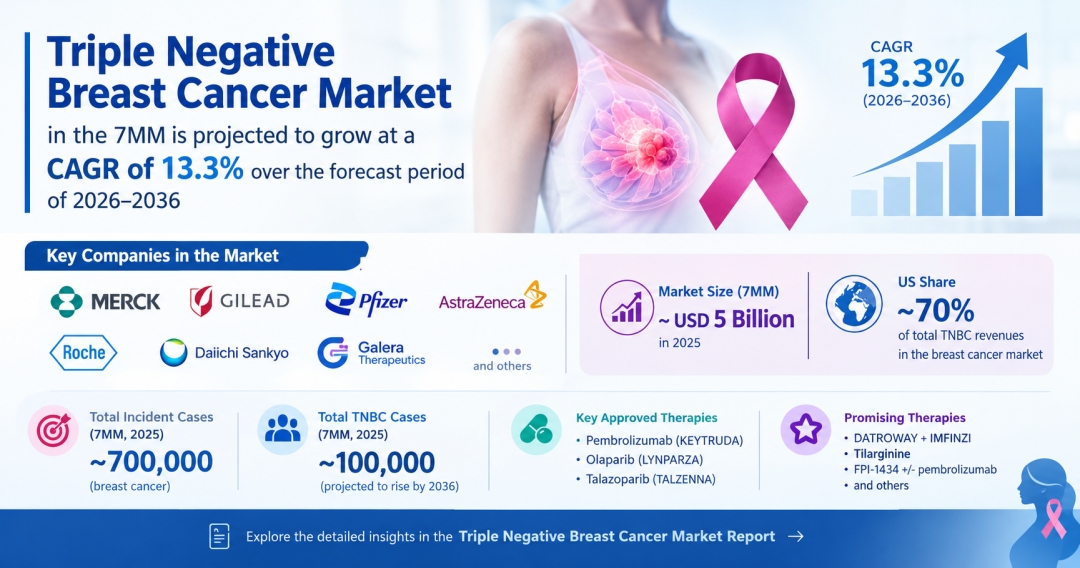
According to DelveInsight’s analysis, the triple negative breast cancer market size was nearly USD 5 billion in the 7MM in 2025, with a projected CAGR of 13.3% during 2026-2036.
-
In 2025, the US accounted for about 70% of total revenues in the breast cancer treatment market for TNBC, followed by the EU4 and the UK, highlighting the weight of the US breast cancer market.
-
The TNBC market size in Japan was valued at approximately USD 200 million in 2025, while Spain accounted for the smallest market among the 7MM countries at nearly USD 100 million.
-
According to DelveInsight’s estimates, the total incident cases of breast cancer in the 7MM were nearly 700,000 in 2025, and cases are expected to rise due to lifestyle changes, obesity, delayed childbirth, alcohol consumption, environmental exposures, and enhanced detection through screening programs.
-
Total incident TNBC cases in the 7MM were approximately 100,000 in 2025, and this figure is projected to rise by 2036.
-
TNBC mostly occurs in younger women before the age for routine screening, so diagnosis relies on patients noticing symptoms, which are often ignored, leading to delayed diagnosis and a worse prognosis.
-
Immunotherapy and targeted therapies have transformed the treatment landscape, with pembrolizumab (KEYTRUDA) now a standard treatment for early-stage TNBC, and PARP inhibitors such as olaparib (LYNPARZA) and talazoparib (TALZENNA) used in BRCA-mutated disease.
-
The leading triple negative breast cancer companies include Merck, Gilead Sciences, Pfizer, AstraZeneca/Merck, Hoffmann-La Roche, and others.
-
Promising triple negative breast cancer therapies include DATROWAY (datopotamab deruxtecan) + IMFINZI (durvalumab), Tilarginine, FPI-1434 +/- pembrolizumab, and others.
Get a Free sample for the Triple Negative Breast Cancer Market Forecast, Size & Share Analysis Report @ Breast Cancer Therapeutics Market
Triple Negative Breast Cancer Overview
Breast cancer is both genetically and clinically diverse, with various subtypes, and the most widely recognized classification is based on immune histochemical analysis of hormone receptors such as Estrogen Receptor (ER), Progesterone Receptor, and Human Epidermal Growth Factor Receptor 2 (HER2). Triple negative breast cancer (TNBC) is an aggressive subtype that develops and progresses quickly. Its distinctive immune microenvironment features elevated levels of vascular endothelial growth factors, tumor-infiltrating lymphocytes, and tumor-associated macrophages, which play a dual role in the development, progression, and spread of the disease. Common imaging methods for diagnosis include mammography, ultrasound, and MRI, while biopsy techniques include core biopsy, fine needle aspiration, stereotactic biopsy, and surgical biopsy.
Triple Negative Breast Cancer Epidemiology Segmentation in the 7MM
-
Total Triple Negative Breast Cancer Incident Cases
-
Triple Negative Breast Cancer Gene Mutation-specific Incident Cases
-
Triple Negative Breast Cancer Stage-specific Incident Cases
-
Triple Negative Breast Cancer Age-specific Incident Cases
-
Line-wise Treated Triple Negative Breast Cancer Incident Cases
-
Triple Negative Breast Cancer Treated Cases
Download the report to understand which factors are driving Triple Negative Breast Cancer Epidemiology trends @ Breast Cancer Market Size
Triple Negative Breast Cancer Epidemiology Key Findings
-
In 2025, the US had the highest number of incident TNBC cases among the 7MM, accounting for nearly 42% of the total cases.
-
The highest number of cases was recorded in individuals under 45 years of age, around 16,000 cases in 2025.
-
In the UK, Stage II TNBC had the highest number of cases in 2025, with nearly 4,000 cases.
-
In Japan, BRCA1-mutated TNBC had the highest number of cases among gene mutation-specific TNBC cases in 2025, nearing 1,000 cases.
Approved Therapies for Triple Negative Breast Cancer
-
Pembrolizumab (KEYTRUDA): Merck
An immunotherapy and humanized monoclonal antibody that blocks the interaction between the PD-1 receptor and its ligands PD-L1 and PD-L2, thereby activating T lymphocytes. In TNBC, KEYTRUDA has been studied in combination with chemotherapy to improve treatment outcomes. It is marketed in the US (2020 and 2021), EU (2021 and 2022), and Japan (2021 and 2022). In May 2024, Merck reported that its Phase III KEYNOTE-522 trial met the overall survival endpoint in patients with high-risk early-stage TNBC.
-
Sacituzumab govitecan-hziy (TRODELVY): Gilead Sciences
Marketed for TNBC in the US (2021), EU (2021), and Japan (2024).
Triple Negative Breast Cancer Pipeline Analysis
-
DATROWAY (Datopotamab Deruxtecan): AstraZeneca/Daiichi Sankyo
Dato-DXd is an investigational antibody-drug conjugate designed to selectively target cancer cells and deliver a potent chemotherapy payload. It is being developed as a precision medicine for TNBC and is studied as a monotherapy and in combination with IMFINZI (durvalumab) in the neoadjuvant and adjuvant settings, as well as for PD-L1-positive patients with locally recurrent inoperable or metastatic TNBC. In October 2025, DATROWAY demonstrated statistically significant and clinically meaningful improvement in overall survival as 1st-line therapy for patients with metastatic TNBC for whom immunotherapy was not an option in TROPION-Breast, and in February 2026 it was granted Priority Review in the US for this setting. The US launch of the combination in PD-L1-positive locally recurrent inoperable or metastatic TNBC is anticipated in 2027.
-
Tilarginine (L-NMMA): Galera Therapeutics – A NOS inhibitor in Phase II for HER2-negative MpBC, administered by IV infusion.
Discover more about therapies set to grab Major Triple Negative Breast Cancer Market Share @ Metastatic Triple-Negative Breast Cancer Market
Triple Negative Breast Cancer Market Outlook
The triple negative breast cancer market is shifting from chemotherapy alone to a more personalized approach that integrates immunotherapy and targeted therapies, significantly improving patient outcomes. Pembrolizumab, olaparib, talazoparib, sacituzumab govitecan, and atezolizumab demonstrate this evolving treatment paradigm. Prior to these developments, taxane-based chemotherapies remained the standard of care for metastatic disease in 1L treatment, with platinum-based chemotherapies also used at times, though their usage is debated because of severe adverse effects and limited PFS benefit. Emerging pipeline therapies such as DATROWAY (± IMFINZI) in the first line and Tilarginine in later lines highlight a shift toward mechanism-driven, combination strategies aimed at overcoming resistance and improving survival outcomes. The growing incidence of TNBC, expanding immunotherapy use, and a robust pipeline are expected to drive growth across the breast cancer market, with the market expected to grow through the forecast period owing to increasing incidence cases and upcoming therapy launches.
Triple Negative Breast Cancer Market Drivers
-
Rising incidence of triple negative breast cancer
-
High unmet medical need
-
Advancements in targeted therapies, including PARP inhibitors and antibody-drug conjugates
-
Increasing adoption of immunotherapy
-
Robust pipeline of emerging therapies
-
Growing focus on precision medicine
-
Favorable regulatory support
-
Rising healthcare expenditure
-
Increasing awareness and early diagnosis
Triple Negative Breast Cancer Unmet Needs
-
Diagnostic delay leading to worsening of patient prognosis
-
Deeper understanding of the heterogeneity of the disease
-
High risk of recurrence and metastasis
-
Lack of reliable biomarkers
-
Need for novel therapies
Triple Negative Breast Cancer Treatment Landscape
Because TNBC lacks hormone receptors and has minimal HER2 expression, hormonal and HER2-targeted therapies are ineffective, so chemotherapy remains the cornerstone of treatment across all stages. In early-stage TNBC, neoadjuvant chemotherapy is often used to reduce tumor size, assess treatment response, and enable breast-conserving surgery, while adjuvant chemotherapy may be recommended depending on residual disease. Common adjuvant combinations include cyclophosphamide, doxorubicin, and paclitaxel, as well as cyclophosphamide with doxorubicin or docetaxel, and capecitabine is often administered for residual disease. For patients with BRCA mutations, PARP inhibitors exploit cancer cells’ impaired DNA repair, and olaparib and talazoparib have shown significant efficacy in prolonging PFS in BRCA-mutated TNBC.
To know more about Triple Negative Breast Cancer Companies working in the treatment market, visit @ Breast Recurrence Score Test Market
Scope of the Triple Negative Breast Cancer Market Report
-
Coverage- 7MM
-
Study Period- 2022-2036
-
Forecast Period- 2026-2036
-
Triple Negative Breast Cancer Companies- Merck, Gilead Sciences, Pfizer, AstraZeneca/Merck, Hoffmann-La Roche, and others.
-
Triple Negative Breast Cancer Therapies- DATROWAY (datopotamab deruxtecan) + IMFINZI (durvalumab), Tilarginine, FPI-1434 +/- pembrolizumab, and others.
-
Triple Negative Breast Cancer Market Dynamics: market drivers and market barriers
-
Triple Negative Breast Cancer Competitive Intelligence Analysis: SWOT Analysis, Conjoint Analysis
-
Triple Negative Breast Cancer Unmet Needs, KOL Views, Reimbursement
Table of Contents
-
Key Insights
-
Report Introduction
-
TNBC Market Overview at a Glance
-
Executive Summary
-
Key Events
-
Disease Background and Overview
-
Epidemiology and Market Forecast Methodology
-
Epidemiology and Patient Population
-
Patient Journey
-
Marketed Therapies
-
Emerging Drug Profiles
-
TNBC: Market Analysis
-
Key Opinion Leaders’ Views
-
Unmet Needs
-
SWOT Analysis
-
Market Access and Reimbursement
-
Appendix
-
DelveInsight Capabilities
-
Disclaimer
-
About DelveInsight
Media Contact
Company Name: DelveInsight Business Research LLP
Contact Person: Abhishek kumar
Email: Send Email
Phone: +19193216187
Address:304 S. Jones Blvd #2432
City: Albany
State: New York
Country: United States
Website: https://www.delveinsight.com/report-store/triple-negative-breast-cancer-tnbc-market


