
Fruit Pectin Market Size Set to Reach USD 1.48 Billion by 2031 Driven by Low-Methoxyl Grades and Pharmaceutical Gel Matrices – Mordor Intelligence
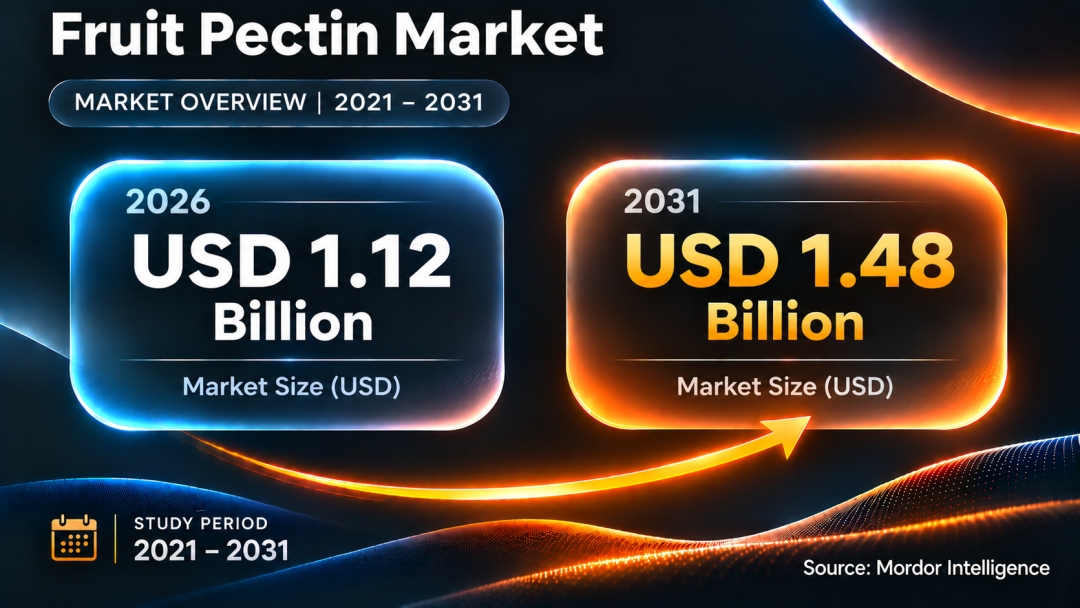
Hyderabad, November 23, 2026: According to Mordor Intelligence, the fruit pectin market size was valued at USD 1.06 billion in 2025, is estimated to reach USD 1.12 billion in 2026, and is forecast to reach USD 1.48 billion by 2031, growing at a CAGR of 5.73% during the forecast period (2026-2031). The market expands as commercial food processors, dairy manufacturers, and pharmaceutical formulators adopt plant-derived hydrocolloids for gelling, thickening, and stabilization. Growing consumer demand for clean-label ingredient lists, widespread reformulation of reduced-sugar food products, and rising utilization of pH-responsive gel matrices in medical applications support procurement volumes across food processing plants, beverage bottlers, and healthcare manufacturing facilities worldwide.
The fruit pectin market growth is also shaped by green extraction engineering, agricultural peel upcycling, and rising food processor expectations regarding batch viscosity consistency and acid stability. Pectin refiners are investing in ultrasound-assisted and enzyme-assisted extraction systems, automated esterification controls, and dedicated citrus peel supply agreements. These processing improvements help ingredient manufacturers lower chemical acid usage during extraction while maintaining precise gelation temperatures, smooth mouthfeel, and clean-label compliance. Together, these factors strengthen the integrated fruit pectin market forecast across established food manufacturing economies and emerging consumer markets.
Fruit Pectin Market Trends
Clean-Label Demand and Reduced-Sugar Formulations Accelerate Low-Methoxyl Pectin Adoption
One of the leading fruit pectin market trends is the rapid shift toward low-methoxyl (LM) pectin across reduced-sugar jams, low-calorie fruit preparations, and plant-based dairy alternatives. While traditional high-methoxyl (HM) pectin requires high soluble solids and acidic conditions to set, low-methoxyl pectin forms stable gels in the presence of calcium ions without added sucrose. Food manufacturers formulating reduced-sugar yogurt fruit bases, diabetic-friendly spreads, and vegan confectionery gummies increasingly specify amidated and non-amidated LM grades to achieve authentic gel texture while lowering caloric content, supporting the fruit pectin industry.
Pharmaceutical Drug Delivery and Medical Applications Expand High-Value Usage
Healthcare and biomedical formulation represents a high-growth development area within the fruit pectin market share. Pharmaceutical researchers and drug manufacturers utilize purified fruit pectin to engineer pH-responsive hydrogel matrices, colon-targeted oral drug carriers, and mucoadhesive wound dressings. Because pectin resists enzymatic digestion in the upper gastrointestinal tract before breaking down in the colon, formulators apply specialized pectin coatings to protect sensitive active pharmaceutical ingredients and control targeted release profiles, aligning with wider quality benchmarks recognized across the integrated food ingredients industry for pharmaceutical-grade biopolymers.
Green Extraction Technologies Improve Yield Efficiency and Sustainability Profiles
Extraction engineering continues to guide capital investments across the fruit pectin market growth and shape modern fruit pectin market trends. Conventional industrial pectin production relies on prolonged hot mineral acid extraction, which generates acidic wastewater streams and requires high thermal energy. Ingredient manufacturers are deploying microwave-assisted, subcritical water, and enzymatic extraction processes that shorten processing times, preserve natural molecular weight, and reduce chemical effluent while extracting high-purity pectin from agricultural fruit processing side-streams.
Citrus Fruits Anchor Raw Material Supply While Apple Pomace Sustains Regional Output
Raw material sourcing continues to influence supply chain stability across international processing plants. Citrus peels—primarily derived from commercial lemon, lime, and orange juice processing—account for the largest proportion of global raw material volume due to their high extractable galacturonic acid content and superior gelling strength. Concurrently, apple pomace remains a vital secondary feedstock across temperate fruit-growing regions in Europe and North America, valued for producing slower-setting pectins suited for smooth bakery fillings and confectionery jellies.
Europe Leads Global Consumption While Asia-Pacific Registers Fastest Expansion
Regional production and consumption patterns continue to guide the fruit pectin market forecast. Europe commands the largest regional market share, supported by mature fruit processing industries, strict clean-label food standards, and high consumer intake of artisanal preserves, dairy desserts, and functional beverages. Meanwhile, the Asia-Pacific region represents the fastest-growing market, propelled by rapid urbanization, expanding packaged food and beverage manufacturing, and rising consumer adoption of protein-fortified acidified dairy drinks across China, India, and Southeast Asia.
Check out more details and stay updated with the latest industry trends, including the Japanese version for localized insights: https://www.mordorintelligence.com/ja/industry-reports/fruit-pectin-market?utm_source=abnewswire
Fruit Pectin Market Segmentation
By Source
-
Citrus Fruits
-
Apple Pomace
-
Others (Sugar Beet Pulp, Sunflower Heads)
By Type
-
High Methoxyl Pectin (HM)
-
Low Methoxyl Pectin (LM)
By Application
-
Food and Beverages (Jams and Preserves, Dairy and Plant-Based Alternatives, Bakery and Confectionery, Beverages)
-
Pharmaceuticals and Nutraceuticals
-
Beauty and Personal Care
-
Others
By Geography
-
North America
-
Europe
-
Asia-Pacific
-
South America
-
Middle East and Africa
Competitive Landscape of the Fruit Pectin Industry
The fruit pectin industry exhibits a moderately consolidated competitive structure, with multinational food ingredient corporations and specialized hydrocolloid refiners competing across raw peel procurement, esterification control, and technical application support. Market leaders strengthen their operational presence by establishing extraction plants near major citrus juice processing hubs in South America and Europe, securing long-term peel supply contracts, and expanding customized pectin blending facilities.
Gelation speed, calcium reactivity, and protein stabilization in acidified beverages serve as primary areas of operational differentiation. Suppliers invest in controlled de-esterification equipment and application laboratories to help food and dairy formulators prevent casein sedimentation in drinking yogurts and plant-based milks, protecting their fruit pectin market share.
Key Players
Major companies operating in the fruit pectin market include:
-
Herbstreith & Fox GmbH
-
Cargill Inc.
-
International Flavors & Fragrances (IFF)
-
Tate & Lyle PLC
-
DSM-Firmenich
Conclusion
The fruit pectin market forecast points toward steady expansion as food processors, dairy brands, and pharmaceutical developers continue adopting plant-based hydrocolloids for sugar reduction, clean-label texturizing, and controlled drug delivery. Ingredient manufacturers respond by scaling green extraction technologies, expanding low-methoxyl product lines, and securing traceable citrus and apple peel supply chains to support global food and healthcare production.
Overall, the fruit pectin market size will continue to benefit from shifting consumer preferences toward natural ingredients, growing demand for reduced-sugar packaged foods, wider adoption in pharmaceutical formulations, and ongoing improvements in extraction efficiency. These combined factors support sustained fruit pectin market growth across the global fruit pectin industry.
Explore Our Trending Reports
Quillaia Extract Market Size: The global quillaia extract market is estimated at $349.85 million in 2026 and is projected to reach $516.29 million by 2031, growing at an 8.10% CAGR. Demand is driven by clean-label reformulation across natural beverages, personal care products, and veterinary vaccine adjuvants utilizing saponin-rich bark extracts as plant-based emulsifiers and foaming agents. Improved extraction yields and expanding regulatory approvals are accelerating commercial adoption, prompting suppliers to prioritize sustainable Quillaia saponaria forestry management and batch traceability.
Citrus Fruit Coatings Market Share: The global citrus fruit coatings market is projected to register a 6.60% CAGR over the forecast period, supported by rising global fresh citrus consumption and export logistics requiring extended post-harvest shelf life. North America commands the largest regional market share alongside strong expansion across Asia-Pacific, as packinghouses deploy hybrid carnauba and ammonia-free shellac coatings to prevent moisture loss and preserve surface gloss during long-haul transit.
Wheat Malt Market Trends: The global wheat malt market is estimated at $5.76 billion in 2026 and is forecast to climb to $8.15 billion by 2031, advancing at a 7.19% CAGR. While craft and specialty brewing remain foundational volume drivers, commercial bakeries and food processors are increasingly adopting wheat malt to enhance crumb texture, natural sweetness, and clean-label positioning. With Europe retaining the largest revenue share and Asia-Pacific exhibiting the fastest growth trajectory, maltsters are differentiating through certified organic production, traceable grain origination, and food-grade specialty formulations.
About Mordor Intelligence:
Mordor Intelligence is a global market intelligence firm, founded in 2014, helping businesses make informed decisions through data-driven insights, industry expertise, and advanced analytics. With 550+ domain experts and on-the-ground specialists across 180+ countries, the company delivers comprehensive intelligence across aerospace & defense, agriculture, automation, automotive, chemicals & materials, consumer goods & services, electronics, energy & power, financial services, food & beverages, healthcare, hospitality & tourism, information & communications technology, and logistics.
Its offerings include syndicated industry reports, custom research and advisory, and subscription platforms such as Data Center Intelligence. Mordor Intelligence is ISO 9001:2015 and ISO/IEC 27001:2022 certified, a member of ESOMAR and the Market Research Society of India, and a four-time Great Place to Work® honoree.
Media Contact
Company Name: Mordor Intelligence
Contact Person: Jignesh Thakkar
Email: Send Email
Phone: +1 617-765-2493
Address:11th Floor, Rajapushpa Summit, Nanakramguda Rd, Financial District, Gachibowli [email protected]
City: Hyderabad
State: Telangana 500008
Country: India
Website: https://www.mordorintelligence.com/industry-reports/fruit-pectin-market?utm_source=abnewswire


